Agent Trace: Capturing the Context Graph of Code
We’re excited to join Cursor, Cloudflare, Vercel, git-ai, Google Jules, Amp, OpenCode and others in support of Agent Trace. As described in the spec, Agent Trace is an open, vendor-neutral spec for recording AI contributions alongside human authorship in version-controlled codebases.
(fun fact: above video was vibed in Windsurf entirely with the Remotion skill!)
Reductively, you can explain this as “a standard way to check in prompts with every commit”, but the spec is actually far more robust and thoughtfully designed than capturing just prompts.
The Central Problem: Throwing Away Context
Foundation Capital recently wrote a viral piece on Context Graphs that they define as:
“a living record of decision traces stitched across entities and time so precedent becomes searchable. Over time, that context graph becomes the real source of truth for autonomy – because it explains not just what happened, but why [it happened].”
Git was made in 2005 when the normal state of code collaboration was to email patches of code back and forth between developers. In other words, commits were expensive/bandwidth constrained, so we committed the bare minimum of what we could: line differences.
20 years later, we have shifted from bandwidth constrained to context constrained. You -can- kloodge things by simply adding prompts as comments and checking them into git, but your code would soon be completely buried under a mountain of comments and your human and AI colleagues would hate you.
Instead, Agent Trace does the smart thing - attribute each change (potentially a git commit, but potentially other more atomic changes) to the specific conversation and line ranges that were associated with that change:
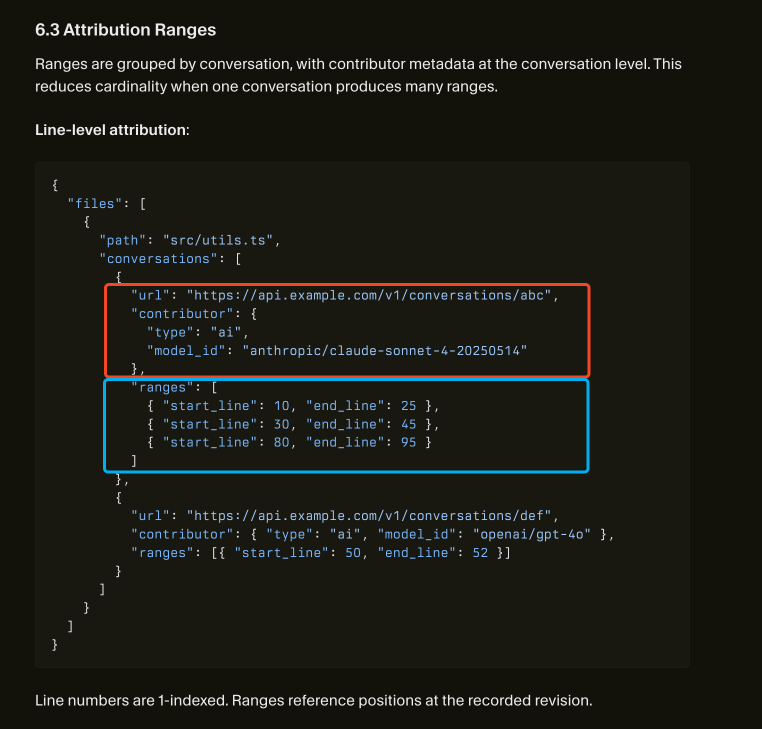
Every one of us in the coding agents industry has independently developed a url identifier for the "chat" or "conversation" or "trajectory" (whatever you call it) where you can retrieve the (potentially long, potentially multimodal) context that would otherwise be impractical to store in an agent trace.
This one basic contract means that a repo with associated Agent Traces will always be able to link back to the context that created it. As a nice bonus, it helps keep PII and other sensitive information out of the agent trace store and top-level access for compatible coding agents that consume Agent Traces.
Useful for Eng Management
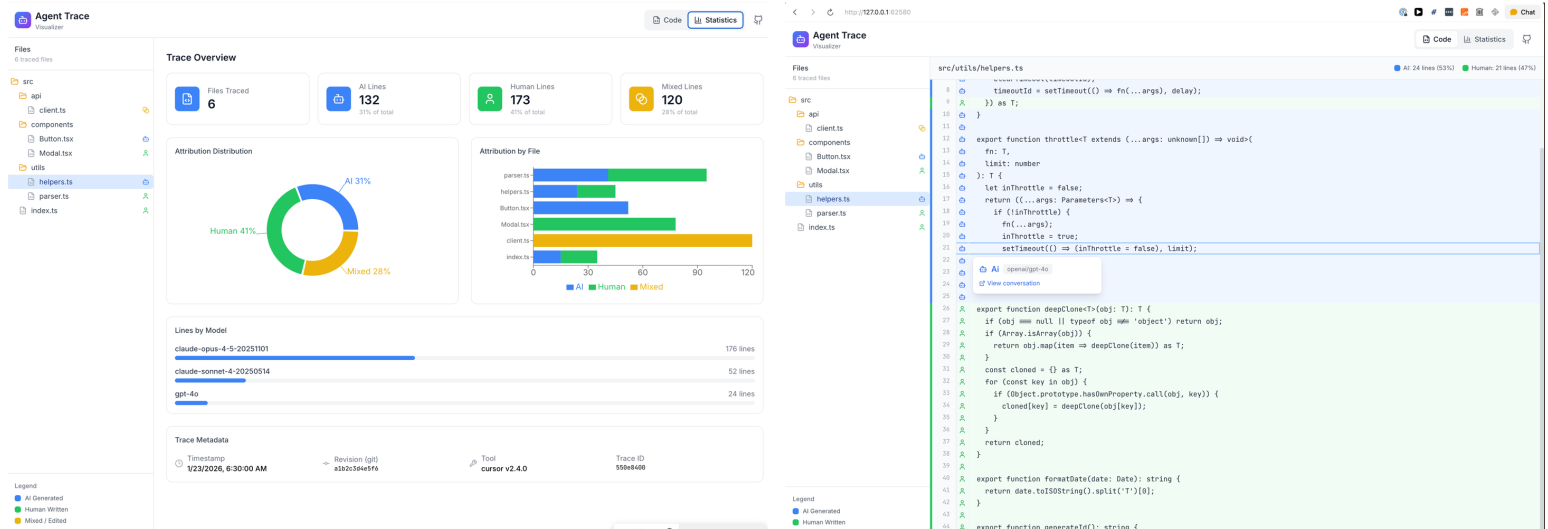
To jog your creativity, here are some of the internal tools we've already built that show what Agent Trace can unlock (all data is mock data unfortunately):
File Viewer that can attribute/blame AI vs Humans:
PR-level breakdown of feature development
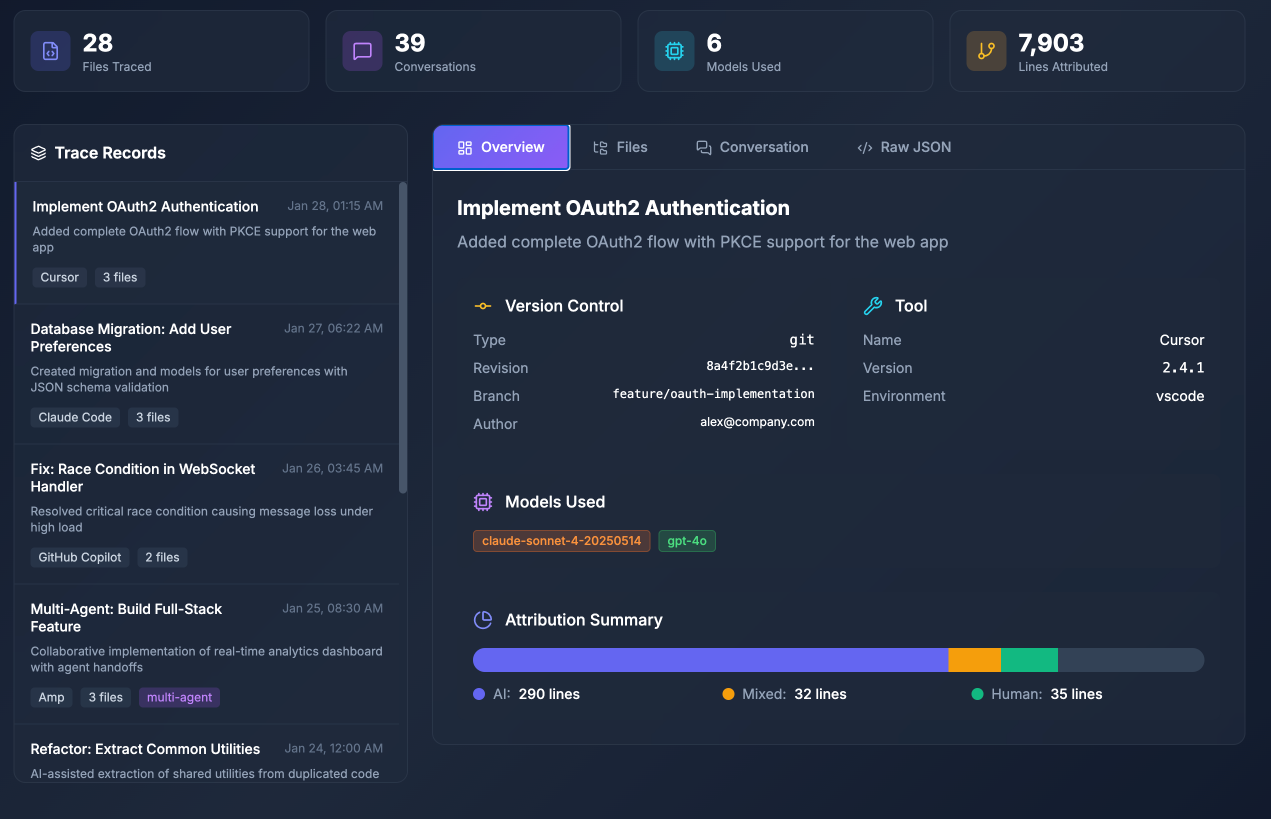
New interfaces for PR review (something we're VERY interested in) with full development context
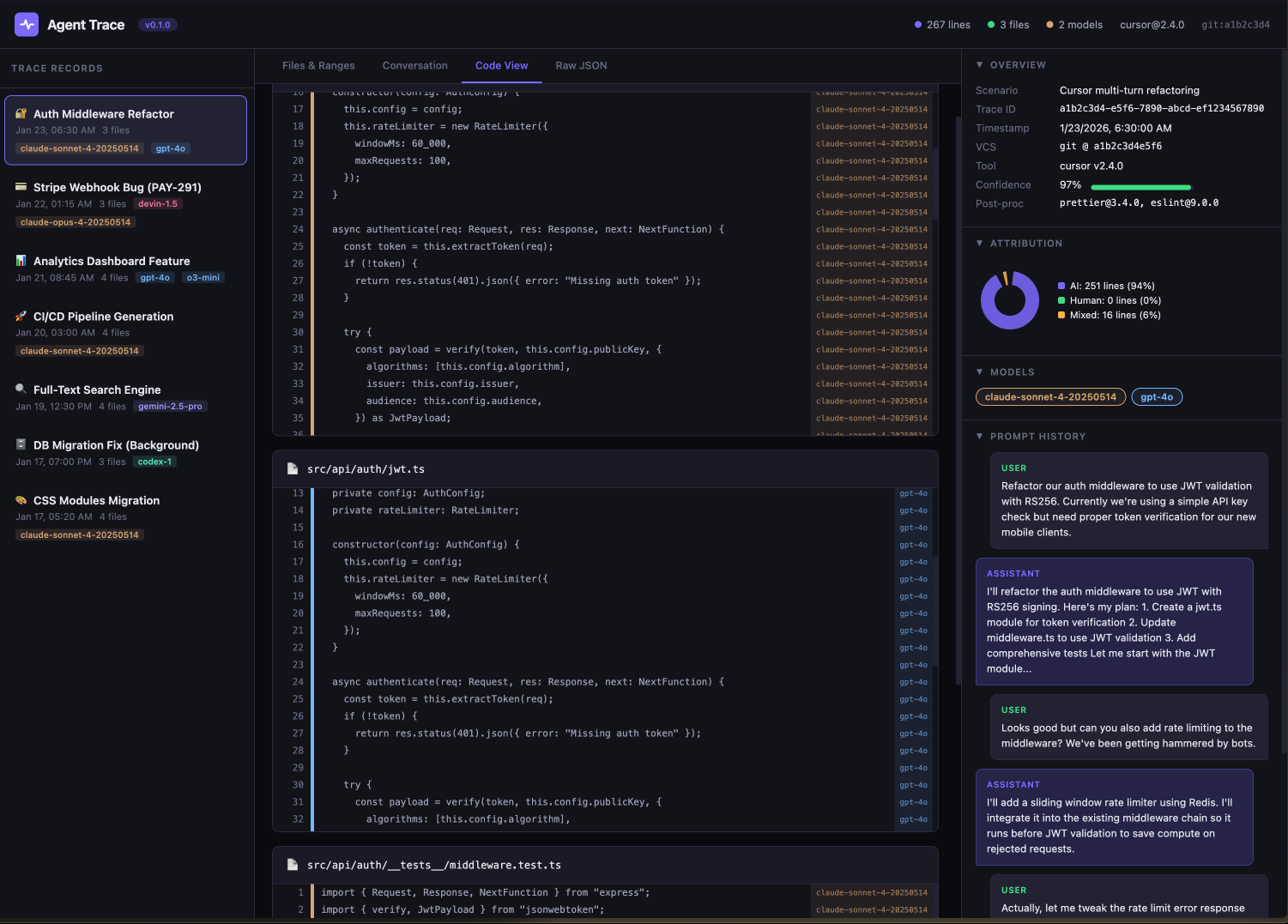
In a scaled org with multiple coding agents and tools and humans all contributing code, you can imagine some pretty powerful management-level dashboards and data-driven decisions made once everyone outputs Agent Traces. Agent Traces make development legible.
Useful for Individual Agent Performance
However we don't mean to cast Agent Traces as "just use it so you know which AI to blame" or "just for pretty dashboards".
With Agent Traced codebases, we think your agents will become a lot smarter and overall waste a lot less time spinning and reinventing wheels.
In 2025, the world learned that including the hidden reasoning artifacts and prior tool calls of models like GPT5 will lead to improvements in intelligence, reportedly by as much as 3 points in SWE-Bench (the difference between SOTA and meh) and cache hit rates improve by 40-80%.
In 2026, Agent Traces that progressively expose context to a coding agent that needs it, will lead to the same kind of performance improvements. In fact, because Agents spend so much more time in inference-time, the ability to retrieve specific context triggered by code will offer improvements not just in cost and accuracy, but also in human time wasted resupplying lost context to the agent.
Context is king. For the model labs, as it is for the agent labs.
Conclusion
If git tracked "Lines of Code" as the primary measure of output of the software engineer in the pre-AI era, then Agent Traces are the beginning of the new era when "Lines of Code" are the commodity, and the new precious resource is context. Whether or not you have 100% AI commits, your AI Engineers (human or otherwise) will spend the majority of their time crafting and reading context more than code.
We're excited to collaborate on a standard that moves the entire industry forward to meet that reality, and unlocks a new generation of AI-native developer tooling and coding agent capabilities that make use of them.


